
TMS Therapy for Depression
Non-invasive depression therapy with no side effects
At Mindwell Urgent Care, we are always staying on the cutting-edge of technology to better help our patients with mental health services. Our Dallas area patients will now have the opportunity to experience Deep TMS therapy for a range of mental health conditions, including depression and OCD, that have not responded well to antidepressant medications or talk therapy alone.
What is TMS?
Transcranial Magnetic Stimulation (TMS) uses gentle magnetic pulses to repeatedly strengthen and enhance communication specifically in the areas of the brain that determine how we act, react, and respond to situations around us. Through repeated treatment sessions, similar to the concept of physical therapy, the brain’s communication and responses improve, reducing symptoms of depression, OCD, anxiety, and even sleep issues.
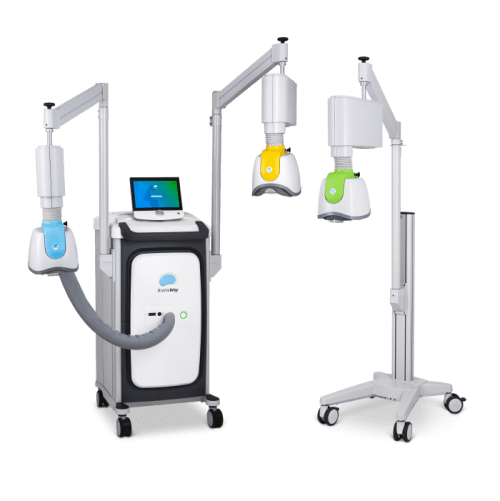
TMS therapy is non-invasive, and involves sitting in a chair with a specially designed helmet that generates magnetic pulses that pass through the skull, stimulating nerve cells. There are no systemic side effects like those seen with antidepressant medications, such as weight gain or gastrointestinal issues. Some patients may experience a headache or mild scalp irritation.
Long Lasting Effects
While the effects of TMS therapy are not permanent, they are long-lasting. Many patients find that their depression symptoms do not return for an extended period of time, while some may require maintenance sessions to sustain the improvements in the nerve cells.
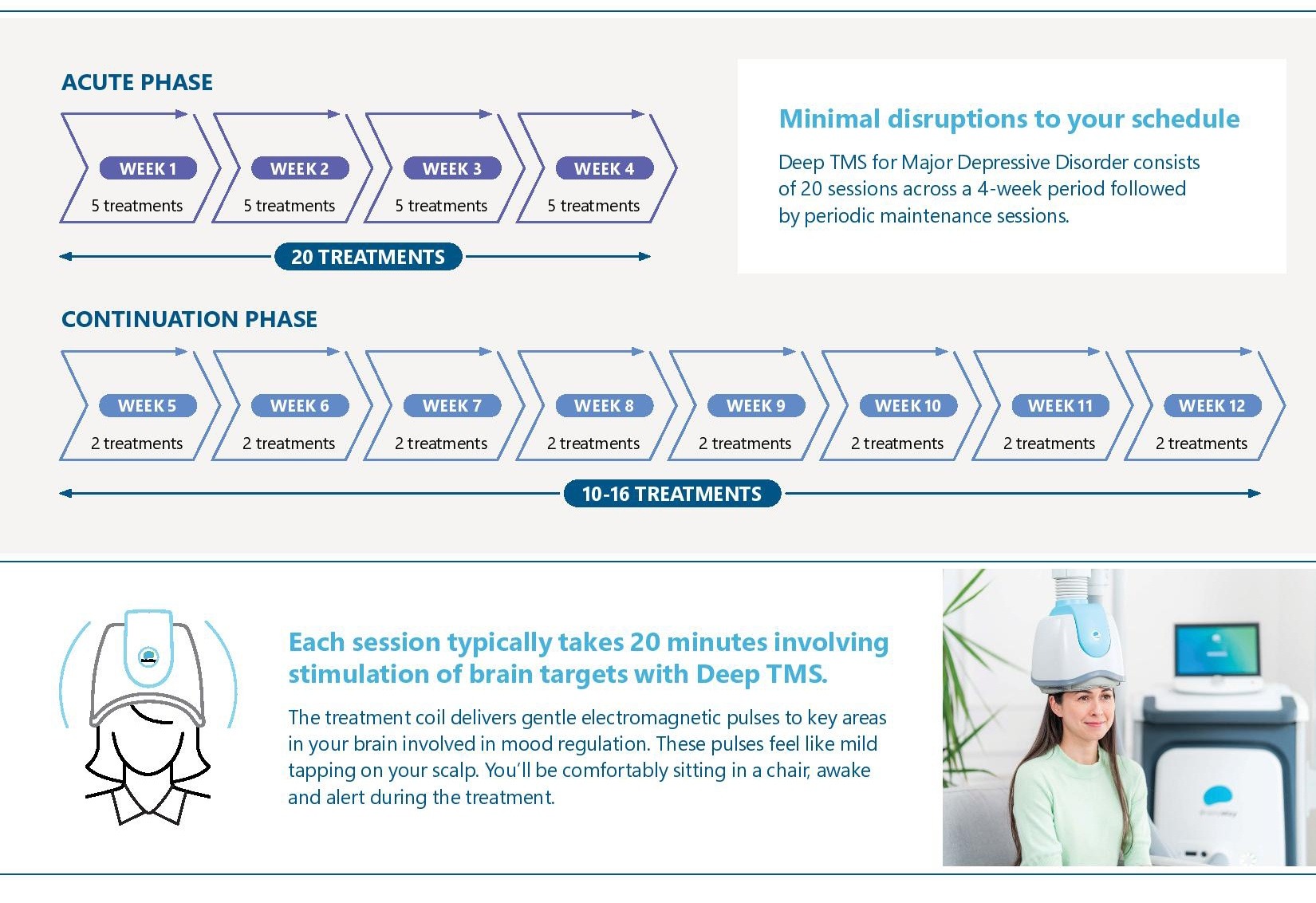
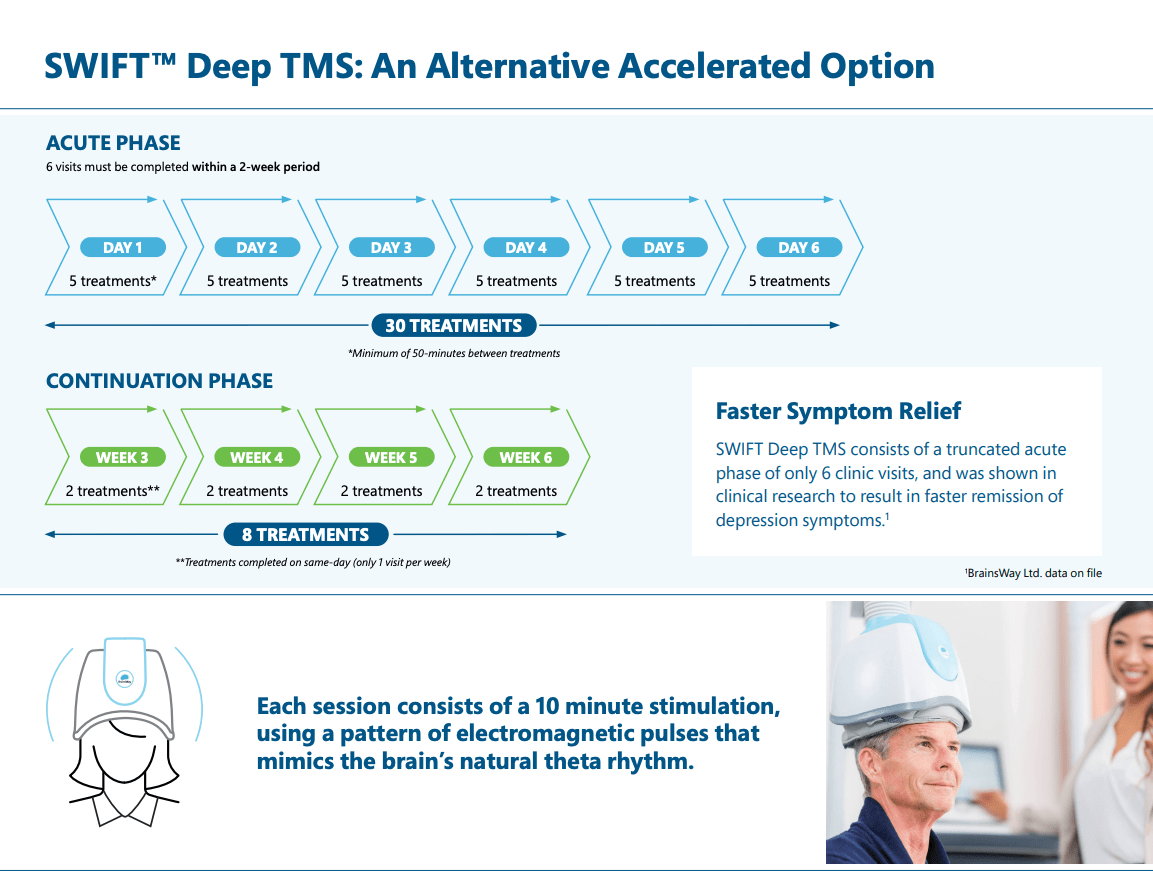
Often an entire course of TMS therapy involves daily treatment sessions over the course of two to six weeks, but treatment durations do vary on an individual basis and treatment protocol. An accelerated option, called SWIFT, is also available for patients who qualify.
Deep TMS vs First-Generation TMS
TMS therapy has actually been used clinically worldwide since 1985. Our particular treatment system is BrainsWay Deep™ – the most advanced TMS technology of its kind with patented deep stimulation H-shaped coils, resulting in greater activation of neurons and less likelihood of targeting errors.
In fact, it’s the only TMS device with peer-reviewed clinical data showing incredible effectiveness on not only Major Depressive Disorder (MDD), but also Anxious Depression, Late-Life Depression, and Obsessive Compulsive Disorder (OCD).
Deep TMS treatment is FDA Approved, and a 2015 multicenter study published in World Psychiatry concluded that one out of three patients facing treatment-resistant depression saw remission after undergoing Deep TMS treatment.
Does Insurance Cover TMS Therapy?
TMS treatment is covered by Medicare and nearly all major private insurers to treat depression, but as always, our staff will check the specifics of your insurance provider to check your eligibility. We also encourage patients to visit our insurance page for a list of common insurance providers and their accompanying websites.
To qualify for TMS therapy, requirements typically include:
- An appropriate diagnosis from a mental health provider with sufficient severity of symptoms.
- Lack of symptom improvement with trials of medications, or inability to tolerate side effects.
- Lack of symptom improvement with trials of psychotherapy.

Our Dedicated Team in Dallas
Mindwell Urgent Care provides in-person mental health services for patients throughout the DFW area at our Dallas office on Mockingbird Lane, just off highway 35 in the hospital district. Care is provided by licensed psychiatric providers, including physicians, nurse practitioners and therapists. Our mental health services in Dallas are under the clinical leadership of Dr. Ashkan Soltan, MD.
While we do also offer telepsychiatry appointments throughout Texas, Oklahoma, New Jersey, Florida, and Kansas, the TMS therapy treatments must be done in-person under clinical supervision. If TMS therapy is determined to be the right fit for you, we will work with you to develop a schedule of recurring treatments over the course of several weeks. Since treatments are non-invasive, patients can drive themselves home and go about their day after sessions with no ill effects.
Find Out if TMS Therapy Could Help You
If you’ve been suffering with the symptoms of depression and medications and psychotherapy are not providing the relief you’re looking for, contact our office to see if TMS therapy might be the right fit for you. You’ll receive a full evaluation and a personalized treatment plan, we’ll explain your options clearly and carefully, and help you develop a plan that feels manageable.
Most of all, at Mindwell Urgent Care, you will feel understood and supported, no matter what particular mental health issues you’re currently facing.
Click Schedule Now to get to our online scheduling software and immediately make an appointment. We are accepting new patients at our newly expanded Dallas practice, and same-week and even same-day appointments are available now.
Frequently Asked Questions About TMS Treatment
How Does Deep TMS Treatment Work?
Deep transcranial magnetic stimulation (Deep TMS™), is a noninvasive treatment process that directly stimulates brain structures associated with mental health conditions like depression. This is done utilizing electromagnetic fields to safely reach deeper brain structures and influence their neural activity.
Who Is Eligible for TMS Treatment?
Eligibility for Deep TMS treatment is determined by a person’s insurance provider. As Deep TMS is safe to combine with other forms of therapy, many insurance providers consider those currently undergoing medical treatment or psychotherapy, as well as treatment-resistant clients, to be eligible for Deep TMS treatment.
Has TMS Treatment Been Extensively Tested?
Deep TMS has been tested in over 60 clinical studies, for various clinical indications, in leading institutions worldwide. The FDA has cleared BrainsWay Deep TMS therapy for treatment-resistant depression and it is currently available in the U.S., Europe, South America, and Asia.
Is TMS Treatment Uncomfortable?
Deep Transcranial Magnetic Stimulation, or Deep TMS, uses magnetic fields to regulate brain structures associated with mood disorders. During the treatment process, patients normally hear a tapping sound and feel some pressure over the treatment site, though these usually go away after several sessions. Deep TMS therapy side effects usually do not cause any persistent discomfort.
How Long Does TMS Treatment Take?
TMS treatment is normally spread out over four-to-six weeks. During this time, patients come in for sessions five times per week and each of these sessions last about 20 minutes. Depending on the mental health condition being treated, there may be additional maintenance sessions after the initial course of treatment. Accelerated options, called SWIFT, are also available for those patients who qualify.
Do I Need To Stop My Medications Before TMS Therapy?
No, you do not need to stop taking your medication. Deep TMS treatment is safe to combine with any sort of medication or psychotherapy.