What Does a Deep TMS Session Feel Like? BrainsWay Therapy Explained

Depression

What Does a Deep TMS Session Feel Like? BrainsWay Therapy Explained

If medication and talk therapy have not brought the relief you hoped for, you may have heard about Deep TMS and still wondered what a session is actually like. Magnetic pulses and a treatment helmet can sound abstract until you know what happens in the chair.

This guide walks you through BrainsWay Deep TMS at MindWell Urgent Care: what it is, how a visit feels, how a full course is structured, and who may be a candidate. Our goal is to keep the process clear and practical so you can decide whether an evaluation makes sense.
TMS Machine

What Is BrainsWay Deep TMS?

Transcranial magnetic stimulation (TMS) uses gentle magnetic pulses to stimulate brain areas involved in mood and how you respond to the world around you. Over repeated sessions—similar in spirit to physical therapy for the brain—communication in those circuits can strengthen, which may help reduce symptoms of depression and related conditions.
 
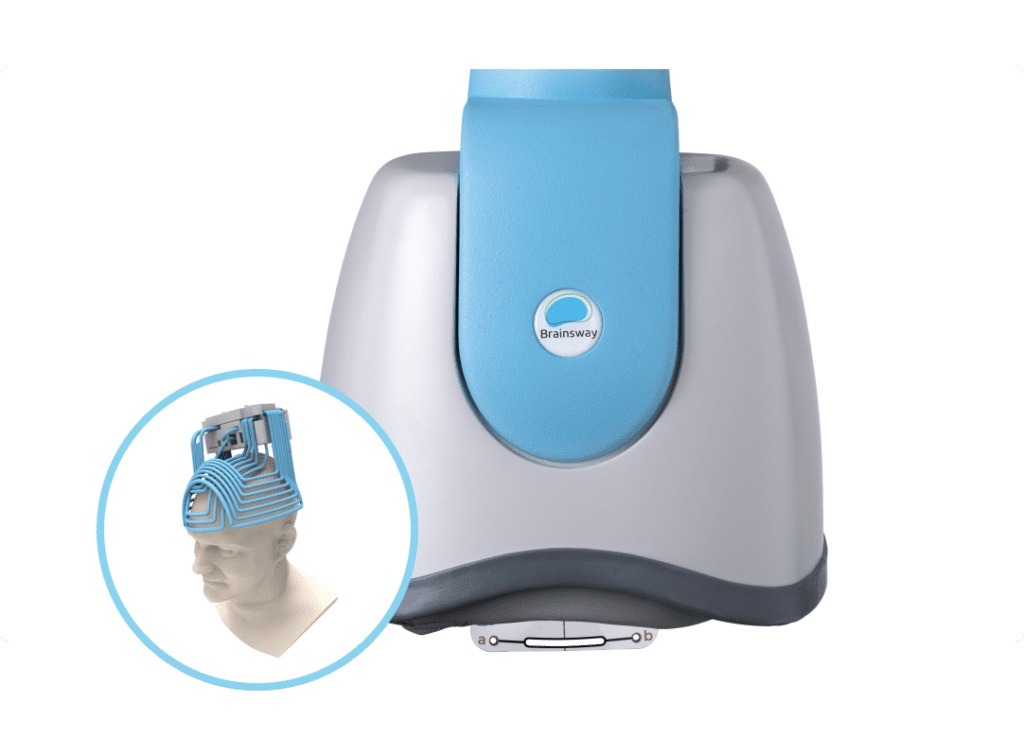
At MindWell, we use BrainsWay Deep TMS. This system uses patented H-shaped coils designed to reach deeper brain structures than first-generation TMS, with the aim of broader neuron activation and fewer targeting errors. Deep TMS is FDA-cleared. BrainsWay is the TMS system with peer-reviewed clinical data for major depressive disorder (MDD), as well as anxious depression, late-life depression, and obsessive-compulsive disorder (OCD).
 
Treatment is non-invasive. You sit in a chair wearing a specially designed helmet that delivers magnetic pulses through the skull. You stay awake the whole time—no surgery and no anesthesia. You also do not need to stop your current medications; Deep TMS is considered safe to combine with medication and psychotherapy.

What a Session Feels Like

Here is the walkthrough most people want before they book: arrival, during treatment, and after you leave.
 
Before you begin:
TMS sessions are in person only at our Dallas office: 1250 W Mockingbird Ln #315, in the hospital district. Telepsychiatry is available for other psychiatric care in Texas, Oklahoma, New Jersey, Florida, and Kansas—but not for TMS treatments themselves.
 
Your path usually starts with an evaluation so we can understand your history, symptoms, and prior treatments, and determine whether Deep TMS is appropriate. 
 
During the session:
Once you are settled and the helmet is positioned, treatment begins. Most people notice two things:
 
– A tapping sound during the pulses
– A sense of pressure at the treatment site on the scalp
Those sensations are expected. For many people, they become less noticeable after several sessions.
 
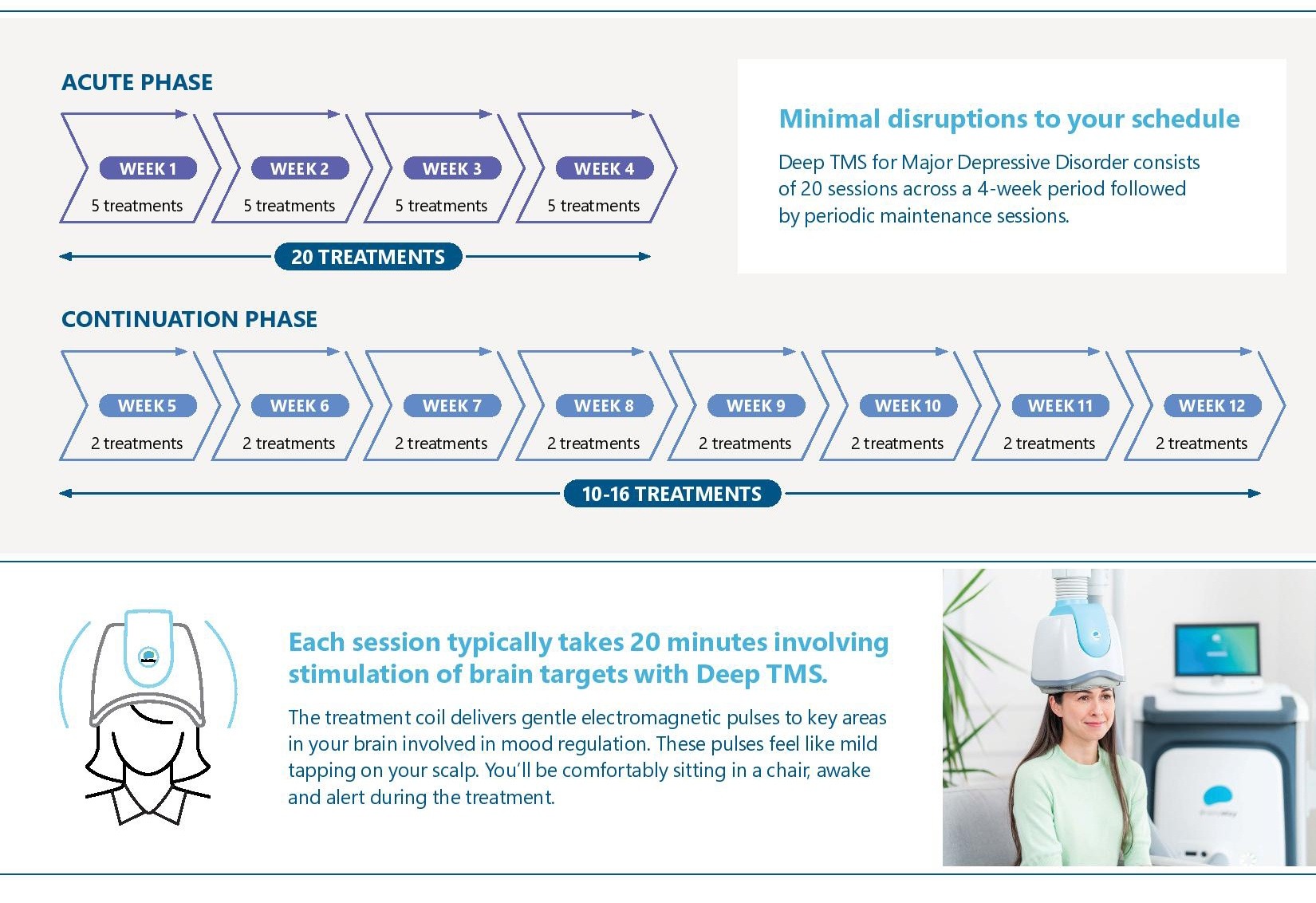
Sessions typically last about 20 minutes. You remain seated and awake; there is no IV and no recovery room the way there is with some other interventional treatments.
 
After the session:
Because Deep TMS is non-invasive, you can usually drive yourself home and return to your day. Mild scalp discomfort or a headache can happen for some people; those effects are generally short-lived.

What a Full Course Looks Like

A typical course of Deep TMS for depression looks like this:
 
– About 20 minutes per session
– Five sessions per week
– Over roughly four to six weeks
 
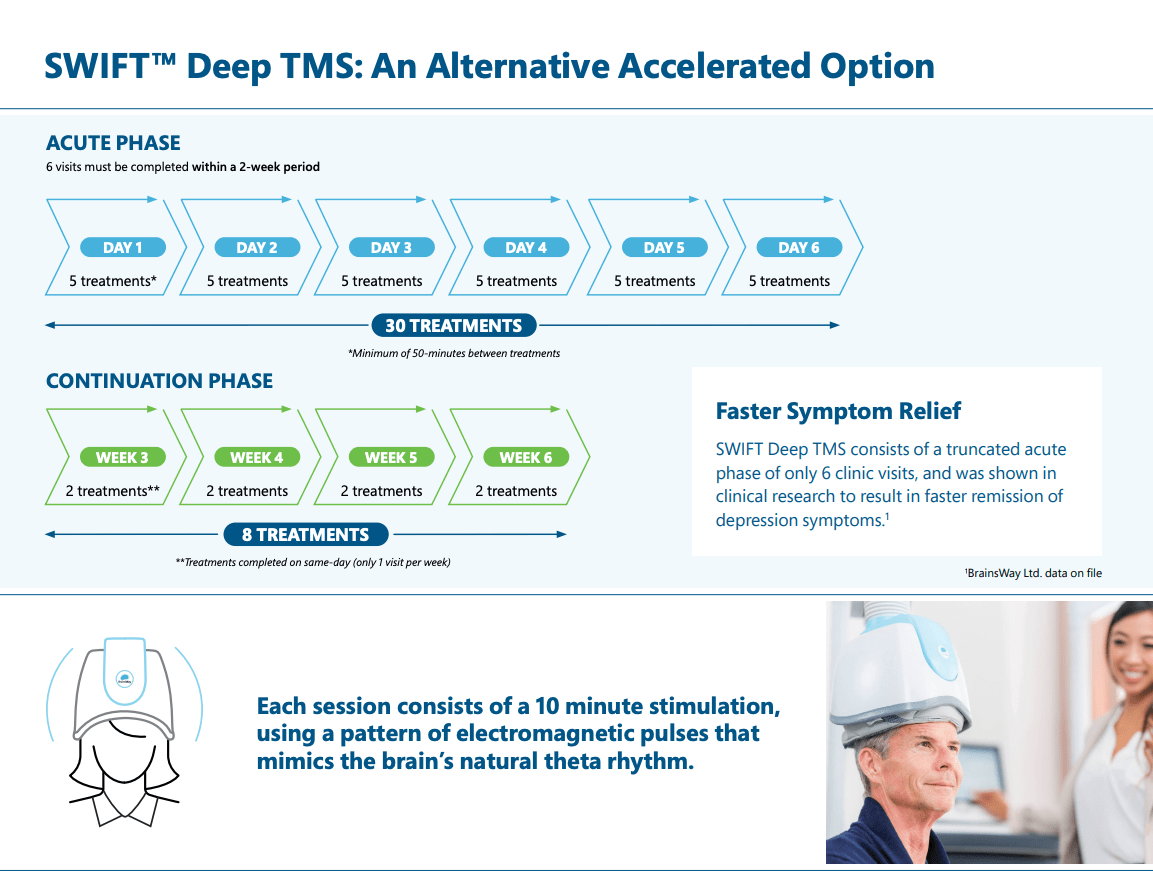
Your exact schedule can vary based on your condition and the protocol we recommend. An accelerated option called SWIFT is available if you qualify; we can discuss that during your evaluation.
 
Effects of TMS are often long-lasting, but they are not permanent. Some people do well for an extended period after the initial course; others need maintenance sessions later to help sustain improvement.
 
A 2015 multicenter study published in World Psychiatry found that about one in three patients with treatment-resistant depression reached remission after Deep TMS. That is a research finding—not a promise of your personal outcome.
TMS Therapy Timeline
SWIFT TMS treatment

Side Effects—and What Deep TMS Is Not

Possible side effects include mild headache or scalp irritation. Tapping and pressure during the pulses usually ease after several visits. Deep TMS does not typically cause whole-body side effects like weight gain or stomach upset that some people get from antidepressants.
 
What it is not: Deep TMS is not electroconvulsive therapy (ECT), does not require anesthesia, and is not available by telehealth. Every treatment session happens in the Dallas office under clinical supervision. It is also not a replacement for a careful clinical evaluation.

Who May Be a Candidate?

Deep TMS is often considered when depression (or another cleared indication, such as OCD in appropriate cases) has not improved enough with standard approaches. Insurance eligibility typically looks at:
 
– An appropriate diagnosis with sufficient symptom severity
– Lack of improvement with medication trials, or inability to tolerate medication side effects
– Lack of improvement with psychotherapy
Eligibility depends on your insurer’s criteria and a clinical evaluation. Being on medication or in psychotherapy does not automatically rule you out. The only way to know if it fits is a conversation with our team.

Does Insurance Cover TMS?

Medicare and nearly all major private insurers cover TMS for depression when medical criteria are met. Coverage is never guaranteed until it is verified. Our staff checks your benefits and clarifies what your plan requires before you commit to a course of treatment.

Ready to Take the Next Step?

If you want a clearer picture of whether BrainsWay Deep TMS could help, start with an evaluation at our Dallas office. We will listen, explain options in plain language, and build a plan that feels manageable—whether that includes TMS or another path forward.
 
Click the Schedule Now button below to be taken directly to our online scheduling portal, or give us a call today. 


Safety Information

If you or someone else is in immediate danger or cannot stay safe, call or text 988 (Suicide & Crisis Lifeline) or go to the nearest emergency room. MindWell Urgent Care provides urgent psychiatric care; we are not an emergency department.